Designing a Human-Centred Learning Journey for Teacher Work-Life Balance
Overview
As part of my Digital Learning Design Diploma, I designed a five-week blended learning and coaching programme to help teachers reclaim time for the people, activities and priorities that matter most to them.
The programme combined asynchronous learning, coaching conversations, community interaction, reflective practice and a virtual coach to create an engaging learning journey designed to support sustainable behaviour change.
The Challenge
Teachers are among the most time-poor professionals, often working evenings, weekends and holidays to keep pace with increasing demands. This can have a significant impact on wellbeing, relationships and long-term career sustainability.
Through learner research and analysis, I identified several limitations in existing approaches:
Many wellbeing programmes were information-heavy and unintentionally added to teachers' workload.
Learning often felt compliance-driven rather than personally meaningful.
Solutions frequently focused on wellbeing interventions, such as mindfulness, while overlooking underlying challenges including workload management, boundaries and competing priorities.
Many programmes focused on supporting teachers to leave the profession rather than helping them create meaningful change within their current circumstances.
This prompted a key design question:
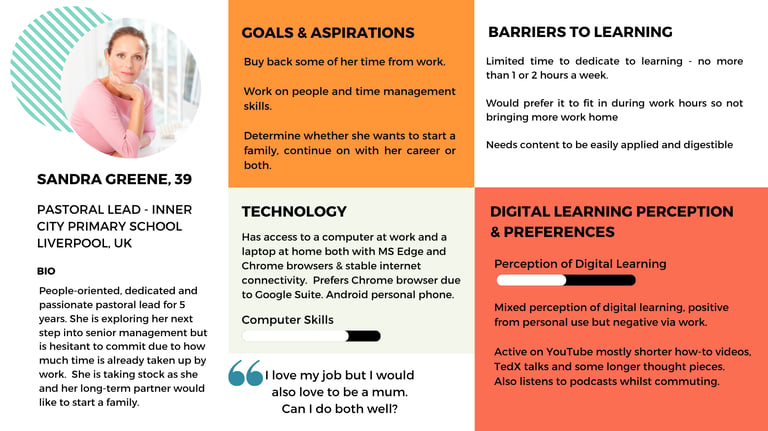
An example Learner persona
How might we create a learning experience that supports teachers to make meaningful changes without creating additional burden?
My Role
I independently designed the programme from concept through to prototype development.
Responsibilities included:
Learner research and needs analysis
Learner persona development
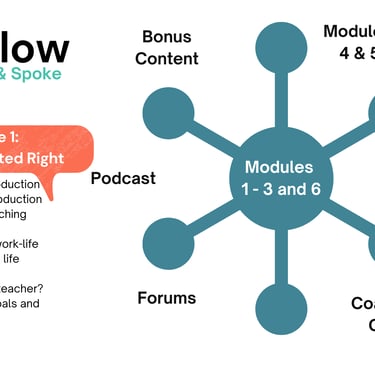
Curriculum architecture and programme design
Learning objective development using Bloom's Taxonomy and SMART principles
Learning journey mapping
Content design and storyboarding
Wireframing and prototype development
Application of ADDIE and SAM instructional design methodologies
My Approach
The programme was designed using a learner-centred approach that integrated learning design, coaching psychology and behaviour change principles.
Macro Design
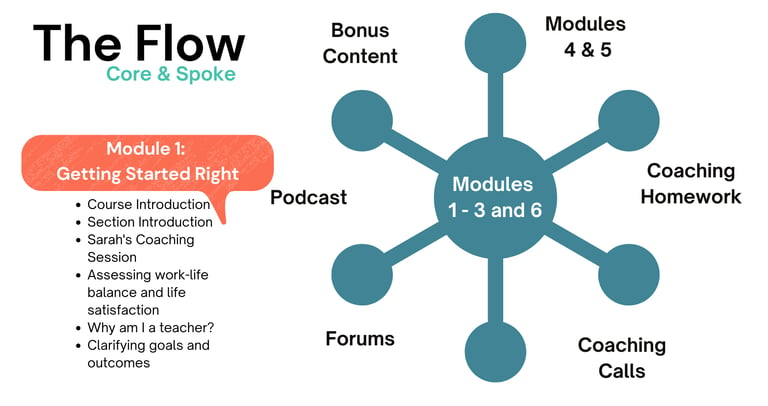
During the macro design phase, I conducted audience analysis, identified learner needs and mapped a complete five-week curriculum designed to support progressive learning, reflection and implementation.
The curriculum was intentionally structured to balance learning with action, ensuring participants could immediately apply concepts within the realities of their daily lives.
Micro Design
During the micro design phase, I developed a working prototype of the first module, including wireframes, storyboards and interactive learning elements.
A key design decision was the introduction of a virtual coach who accompanied learners throughout the programme. Rather than acting as a passive narrator, the coach guided learners through reflection, branching scenarios and practical decision-making activities.
This approach was designed to replicate some of the benefits of a coaching relationship while maintaining the scalability of a digital learning solution.
The programme drew on principles from Applied Positive Psychology and Coaching Psychology alongside Experiential Learning Theory and Social Constructivism.
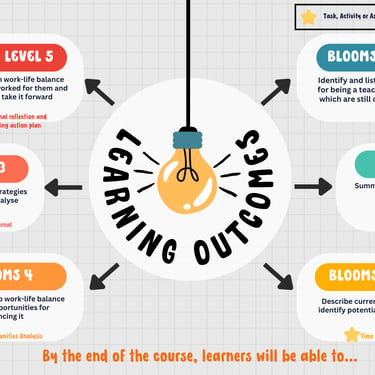
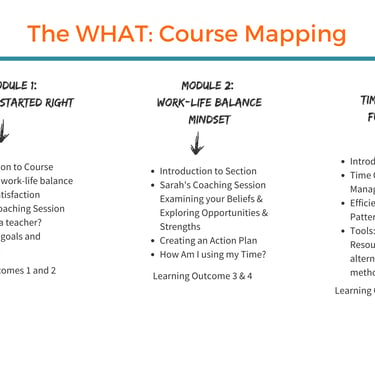
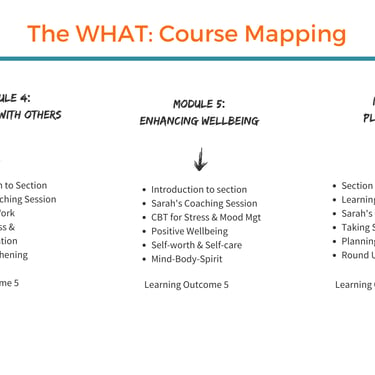
Learning outcome & Course mapping
Key Design Decisions
Virtual Coach
A virtual coach was introduced to create continuity, support reflection and encourage learner accountability throughout the programme.
Why?
Research suggested that teachers often struggled not because they lacked information, but because they needed support translating insights into action.
Scenario-Based Learning
Branching scenarios and role-play activities were incorporated to encourage active participation and practical application.
Why?
The aim was to move learners beyond passive content consumption and into meaningful reflection and decision-making.
Blended Learning Experience
The programme combined self-paced digital learning with coaching-inspired activities and opportunities for reflection.
Why?
Behaviour change is rarely achieved through information alone. The learning experience was designed to support implementation as well as understanding.
What Made This Project Different?
Rather than treating wellbeing as a content challenge, this project approached wellbeing as a behaviour change challenge.
The focus was not on delivering more information, but on creating conditions that supported reflection, decision-making and action.
By combining learning design with coaching psychology principles, the programme explored how digital learning could support sustainable change while remaining engaging, practical and scalable.
Human Insight
This project reinforced an insight that continues to shape my work today:
People rarely struggle because they lack information. More often, they struggle because solutions fail to account for the realities of their lives, environments and competing demands.
Designing for sustainable change means designing with human experience at the centre.
Tools Used: iSpring Suite | Vyond | Canva | Wave Video | Audacity
You may also be interested in the following projects:
© 2026 Florence Ukpabi. All rights reserved.